Executive Solution Overview
[contentstore.ple.platoweb.com/content/sharedmedia/Tracker/applications/spring-wars/spring-wars.html](https://contentstore.ple.platoweb.com/content/sharedmedia/Tracker/applications/spring-wars/spring-wars.html) In this activity, you’ll use a video measurement and analysis tool called Tracker. Tracke…
Instant Solution Download
$6.99Immediate access to the full model answer, formatted citations, and rubric breakdown.
Need a Fresh Custom Paper?
Have this question answered from scratch according to your specific instructions and deadline.
Order on TutorsGallery →Assignment Prompt & Instructions
[contentstore.ple.platoweb.com/content/sharedmedia/Tracker/applications/spring-wars/spring-wars.html](https://contentstore.ple.platoweb.com/content/sharedmedia/Tracker/applications/spring-wars/spring-wars.html)
In this activity, you’ll use a video measurement and analysis tool called Tracker. Tracker enables you to create two different types of mathematical models: analytical and dynamic. In an analytical model, you can enter mathematical expressions for _x_ and _y_ positions as a function of time. That’s sometimes useful, but from a physics perspective, a dynamic model is much more flexible and powerful.
With a dynamic model, you can set the initial conditions for a particular system (initial positions and velocities); then you can mathematically define any forces acting on that system. Once those are set up, the model becomes like an object in space, responding to the forces you’ve imposed on it. It might continue moving forever, if that’s what the forces would do to an object in real life. By visually matching a marker for your model to the real motion on the video, you can define and refine a mathematical model for a wide range of real-world situations.
In this activity, you’ll use Tracker to observe the displacement, velocity, and acceleration of a mass on a spring. Tracker is a free scientific tool available through the Open Source Physics Project.
**Preparation – Creating a Dynamic Particle Model**
If you’ve never built a dynamic model before using Tracker, you’ll need to prepare a bit and find out where you can get help in creating your models. In Tracker, you can always access illustrated Help. For this project, you’re going to need to check out the Tracker Help instructions for creating a dynamic model.
In Tracker, just click on the **Help** **menu**, then, click **Tracker** **Help**. In the Tracker Help window, click **Particle** **Models**. This short, illustrated document tells you everything you need to know to create a dynamic particle model in Tracker. You can print this Help document, but it is available from Tracker anytime you need to refer to it.
**Instructions – Building your Dynamic Model**
Start your activity by opening this Tracker experiment: [Spring Wars model](https://app.edmentum.com/redirect//343215)
Click play  to watch the video. The other video controls allow you to rewind  the video or step forward  or backward  one frame at a time.
You’ve seen the motion of a mass on a spring where the motion is largely “undamped”; that is, it continues for a very long time at about the same amplitude. There are two common ways to slow down an object in harmonic motion:
– kinetic friction – directly proportional to weight and opposite the direction of velocity
– spring damping – directly proportional to velocity and opposite the direction of velocity
Both of these damping forces are at work in this video, but the frictional force is by far the most significant here.
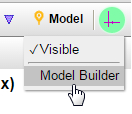
A dynamic model is already started for you in this file. Follow the two steps in the screen captures below to open the model setup and begin your modeling work.
1. Select the point mass **Model**.
(from the blue pull-down control in the top menu)
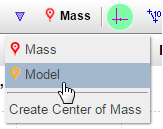
1. Open the **Model Builder**.
(from the “Model” mass pull-down menu)
1. Once you’ve opened the Model Builder screen, use the **Tracker Help** documentation to begin filling out the basic information about this motion. You only have complete data table information starting at time _t_ = 0.00 seconds, so use that as your initial time. Enter data in each of the three sections:
– parameters –Set m = 0.250 kilograms. Add a parameter _k_ for the spring constant and a parameter _mk_ for the coefficient of kinetic friction.
– initial values – From the data table, enter those that apply to this _x_-direction motion: _t_, _x_, and _vx_.
– force functions – It will be easier and cleaner to enter the force function as a sum of two forces, the spring force and the frictional force: _**fx**_: _Fs_ + _Ff_. (Notice that this section turns red after you enter the force functions, since you have not defined _Fs_ and _Ff_ yet.)
– Add a new force function for _Fs_, the spring force. Note that the equilibrium point is at _x_ = 0, so this force law should be pretty easy for you.
– Add a new force function for _Ff_, the frictional force.
Frictional force is defined as _Ff_ = _µkmg_, where _µk_ is the coefficient of kinetic friction. Since this force has to be opposite the direction of motion, though, and since the direction of motion keeps changing, you must use a little creativity to define it. You basically just need something that will output +1 or -1, depending on the direction of your velocity.
vx|vx|can be your “magic factor” here: +1 if velocity is (+) and -1 if velocity is (-).
So, you just need to figure out how to write the following expression into the Tracker model:
Ff=−μkmg(vx|vx|)
1. Finally, to make your model work, you’ll have to find values for the spring constant _k_ and the coefficient of friction _μk_. You’ll just have to play around with _μk_, but you can get close to the spring constant value by looking at some of your data. The first question below will help you with that.
## **Part A**
Calculate the spring constant.
– Look at the graph of _x_ vs. _t_ graph. (You may want to double-click on it to examine it in the **Data Tool** view.)
– From the graph, determine the period _T_.
– The first video frame lists the mass.
– Use the equation below to solve for the spring constant _k_. Show your work below.
T=2π square root mk
15pxSpace used(includes formatting): 0 / 30000
## **Part B**
Enter into the table your calculated value for the spring constant, then play with different values of mk until you get a close match to the motion. (Note: It will never be perfect. Remember that there are two kinds of spring damping. Both are at work here, but we are not going to model both.) Once you’re satisfied with your model, record your model values in the table below.
Variables Expression
parameter: _m_
parameter: _k_
parameter _: mk_
initial value: _t_
initial value: _x_
initial value: _vx_
_fx_
_Fs_
_Ff_
10ptSpace used(includes formatting): 1376 / 30000
## **Part C**
Describe how your model works compared to the actual spring motion. When are they close together? When are they not so close?
15pxSpace used(includes formatting): 0 / 30000
## **Part D**
Now that you’ve had some experience with damped harmonic motion, describe two different real-world harmonic motions you’ve seen—one with very little damping and the other with noticeable damping. Describe how those two motions differ and are the same.
15px
## **Amusement Park Physics**
Amusement parks provide many hours of fun, but did you know you can also practice your physics there? Yes, parks rides rely on physics to function. Let’s look at rides that travel in a circular path, such as a roller coaster or carousel. These rides illustrate the concept of centripetal force. We will also consider the sensation of being pulled to the outside of these rides, which we call centrifugal force.
## **Part A**
Why do we experience centripetal force and acceleration on a carousel?
15pxSpace used(includes formatting): 0 / 30000
## **Part B**
Many people believe that it is centrifugal force that causes the sensation of being pulled to the outside on a carousel. What accounts for this common misconception?
15pxSpace used(includes formatting): 0 / 30000
## **Part C**
Research how a centrifuge works. Relate the mass of an object to its centripetal force, and give examples of how centrifuges are used. Include at least two authoritative research sources to support your response. Record these sources at the end of your response.
15pxSpace used(includes formatting): 0 / 30000
– 2 years ago
– 23.5
Leave a Reply