Category: Corporate Finance & Strategic Management

  • [Solved] Case Study: Global Marketing Ethics

    ✓ Verified Academic Solution Available

    Executive Solution Overview

    [>Operations Management homework help](https://www.sweetstudy.com/fields/business-finance-operations-management) **100 Points** Due Date: Sun, Oct 04, 2:59 AMClose Date: Sun, Oct 11, 2:59 AMSubmission Requirement: Up to 1 file allowed Individual case study · 100 points · Due Week 4 Analyse a marketi…

    Instant Solution Download

    $6.99

    Immediate access to the full model answer, formatted citations, and rubric breakdown.

    Need a Fresh Custom Paper?

    Have this question answered from scratch according to your specific instructions and deadline.

    Order on TutorsGallery →

    Assignment Prompt & Instructions

    [>Operations Management homework help](https://www.sweetstudy.com/fields/business-finance-operations-management)

    **100 Points**

    Due Date: Sun, Oct 04, 2:59 AMClose Date: Sun, Oct 11, 2:59 AMSubmission Requirement: Up to 1 file allowed

    Individual case study · 100 points · Due Week 4

    Analyse a marketing decision where a firm operating across borders faced an ethical problem that a single-market firm would not have faced.

    The interesting cases are where local practice, local law and the firm's stated global values do not agree. Consider marketing to different standards in different countries, labour or sourcing in the supply chain, environmental claims that hold in one market and not another, data practices under differing regimes, or advertising norms that travel badly.

    Address: • What made this specifically a global problem rather than a general ethical one? • Which cultural, economic or regulatory differences created the conflict? • How did the firm resolve it, and what did that cost them in each market? • Where does 'adapt to local norms' stop being respect and start being convenience?

    Take a defended position on what the firm should have done.

    – a month ago

  • [Solved] eeiigghhtt

    ✓ Verified Academic Solution Available

    Executive Solution Overview

    [>Accounting homework help](https://www.sweetstudy.com/fields/business-finance-accounting) **files (1)** – ## eigghtt.docx **## eigghtt.docx** The Term Paper is the culminating assignment in this course and gives you the opportunity to explore a curriculum topic that connects to your professional co…

    Instant Solution Download

    $6.99

    Immediate access to the full model answer, formatted citations, and rubric breakdown.

    Need a Fresh Custom Paper?

    Have this question answered from scratch according to your specific instructions and deadline.

    Order on TutorsGallery →

    Assignment Prompt & Instructions

    [>Accounting homework help](https://www.sweetstudy.com/fields/business-finance-accounting)

    **files (1)**

    – ## eigghtt.docx

    **## eigghtt.docx**

    The Term Paper is the culminating assignment in this course and gives you the opportunity to explore a curriculum topic that connects to your professional context and the ideas we have studied throughout the semester. Your final submission is a 2,500–3,000 word paper that builds on earlier course work and aligns with the course assignment expectations and rubric.

    **How to Complete the Term Paper** **Step 1 — Choose a Curriculum Research Question**

    Select a curriculum-related issue, trend, or problem that connects to course readings and your professional setting. This question will guide your analysis and writing.

    Research Question:

    How do curriculum standardization and district-mandated pacing guides affect the pedagogical agency of K–12 teachers to adapt instruction for diverse student needs within an accountability-driven educational system?

    This is what the professor states the focus should be:

    The key will be for you to define pedagogical agency and to ensure that this definition is reflected in the literature.

    **Step 2 — Prepare Your Working Outline**

    Before submitting the final paper, you will complete a working outline and annotated sources check-in. This step helps you organize your ideas and gather research before writing the full paper.

    Your outline should:

    · Identify your main argument or focus

    · Include key supporting sources

    · Show how your ideas connect to curriculum concepts from the course

    **Step 3 — Write the Final Paper**

    Using your outline, develop a clear and well-organized narrative that:

    · Applies course concepts and readings

    · Uses sources to support your thinking

    · Provides examples from your professional or educational context

    The syllabus reminds students to:

    · Support your position with sources that inform it

    · Provide examples when appropriate

    · Proofread carefully and use correct grammar and structure

    **Step 4 — Apply APA Formatting**

    Follow APA guidelines for citations, references, and overall formatting. Writing quality and organization are part of the evaluation.

    **Step 5 — Submit Your Final Term Paper**

    Upload your completed 2,500–3,000 word paper (Single space)

    In short:

    · You can build off the topic from last assignment

    · 2,500-3,000 words (5-6 pages single spaced)

    · APA 7

    · Title page, citations, reference page

    · 200- word maximum abstract

    · 10 or more peer-reviewed articles or other quality sources

    · Multiple headings: introduction, subheadings, conclusion

    · Limited quotations; stronger emphasis on paraphrase and synthesis

    · Present a clear curriculum research question/topic

    · Develop a strong thesis/position

    · Discuss and synthesize literature (
    **The emphasis on how you use the supporting literature differentiates this assignment from the two previous assignments).**

    · Present multiple perspectives where appropriate

    · Include pedagogic and/or curricular application in the students current educational setting (7th grade Reading Teacher)

    · Maintain academic tone and writing quality

  • [Solved] Due September 27

    ✓ Verified Academic Solution Available

    Executive Solution Overview

    [>Management homework help](https://www.sweetstudy.com/fields/business-finance-management) – [\ \ 20260922_170944.jpg](https://www.sweetstudy.com/files/20260922-170944-jpg "20260922_170944.jpg") – [\ \ 20260922_173934.jpg](https://www.sweetstudy.com/files/20260922-173934-jpg "20260922_173934.j…

    Instant Solution Download

    $6.99

    Immediate access to the full model answer, formatted citations, and rubric breakdown.

    Need a Fresh Custom Paper?

    Have this question answered from scratch according to your specific instructions and deadline.

    Order on TutorsGallery →

    Assignment Prompt & Instructions

    [>Management homework help](https://www.sweetstudy.com/fields/business-finance-management)

    – [\
    \
    20260922_170944.jpg](https://www.sweetstudy.com/files/20260922-170944-jpg "20260922_170944.jpg")
    – [\
    \
    20260922_173934.jpg](https://www.sweetstudy.com/files/20260922-173934-jpg "20260922_173934.jpg")

    – a month ago

  • [Solved] Business Finance – Operations Management Organizational Change Effort Assignment

    ✓ Verified Academic Solution Available

    Executive Solution Overview

    [>Operations Management homework help](https://www.sweetstudy.com/fields/business-finance-operations-management) ## Overview Kotter tells a story in _Our Iceberg Is Melting_ about a situation that needs change intervention. Review the reading.Then write a journal entry describing an organizational c…

    Instant Solution Download

    $6.99

    Immediate access to the full model answer, formatted citations, and rubric breakdown.

    Need a Fresh Custom Paper?

    Have this question answered from scratch according to your specific instructions and deadline.

    Order on TutorsGallery →

    Assignment Prompt & Instructions

    [>Operations Management homework help](https://www.sweetstudy.com/fields/business-finance-operations-management)

    ## Overview

    Kotter tells a story in _Our Iceberg Is Melting_ about a situation that needs change intervention. Review the reading.Then write a journal entry describing an organizational change effort that you are familiar with.

    Include what was done well, what was done poorly, and what was lacking in the change effort. The journal assignment should be a total of 4 paragraphs. Journals are private between the student and the instructor. Each journal will have its own rubric.

    ## Directions

    Your assignment must include the following critical elements:

    – Analyze and state what was **done well** in the organization.
    – Analyze and state what was **done poorly** in the organization.
    – Describe what was **lacking** in the change effort.

    ## What to Submit

    Submit your assignment as a 1 page Word document with double spacing, 12-point Times New Roman font, one-inch margins, and references cited in APA format.

  • [Solved] Presentation

    ✓ Verified Academic Solution Available

    Executive Solution Overview

    [>Economics homework help](https://www.sweetstudy.com/fields/business-finance-economics) Overview Kotter tells a story in Our Iceberg Is Melting about a situation that needs a change intervention. create a presentation that explains how Kotter’s first four steps were applied in the story. You can us…

    Instant Solution Download

    $6.99

    Immediate access to the full model answer, formatted citations, and rubric breakdown.

    Need a Fresh Custom Paper?

    Have this question answered from scratch according to your specific instructions and deadline.

    Order on TutorsGallery →

    Assignment Prompt & Instructions

    [>Economics homework help](https://www.sweetstudy.com/fields/business-finance-economics)

    Overview Kotter tells a story in Our Iceberg Is Melting about a situation that needs a change intervention. create a presentation that explains how Kotter’s first four steps were applied in the story. You can use Microsoft PowerPoint Directions Your assignment must include the following critical elements: Analyze and state how Kotter’s first four steps applied to the story. Provide evidence of being able to lead a change effort. Apply Kotter’s first four steps to diagnose the strengths and weaknesses of the change effort. What to Submit Your presentation must have 6 slides and cite sources using APA style. For assistance, use the Shapiro Library Research Guide: APA Style.

  • [Solved] us

    ✓ Verified Academic Solution Available

    Executive Solution Overview

    [>Economics homework help](https://www.sweetstudy.com/fields/business-finance-economics) [People’s History of Abortion Care in the United States – Zinn Education Project](https://www.zinnedproject.org/materials/peoples-history-of-abortion-care-in-the-us/) ## **Abortion and reproductive justice** are…

    Instant Solution Download

    $6.99

    Immediate access to the full model answer, formatted citations, and rubric breakdown.

    Need a Fresh Custom Paper?

    Have this question answered from scratch according to your specific instructions and deadline.

    Order on TutorsGallery →

    Assignment Prompt & Instructions

    [>Economics homework help](https://www.sweetstudy.com/fields/business-finance-economics)

    [People’s History of Abortion Care in the United States – Zinn Education Project](https://www.zinnedproject.org/materials/peoples-history-of-abortion-care-in-the-us/)

    ## **Abortion and reproductive justice** are key issues that feminists have worked on starting in the second wave of feminism.

    ### Key terms

    – **Pro-choice**: in favor of a person’s right to choose to have an abortion
    – **Pro-life**: against a person’s right to choose to have an abortion

    Abortion is a very hot topic in the US.  According to Pew Research Center, as of 2022 61% of US adults think abortion should be legal in all or most cases ( **pro-choice**).  31% of US adults think abortion should be illegal in all or most cases ( **pro-life**).  _The remaining 8 percent fall somewhere in the middle or declined to provide an opinion._

    ### **The history of abortion in the U.S.**

    – Before 1973: abortion was illegal in most states, but not all
    – For example, in California, abortion was illegal from 1900 to 1962. In 1962, California law began allowing abortions in special circumstances. In 1967, California legalized abortion, but placed various restrictions on when and why the procedure could be performed.
    – The map below shows the United States as of the early 1970s.  Dark red states had repealed their antiabortion laws.  Pink states, like California, had reformed their antiabortion laws to allow abortions in some cases.  In gray states, abortion was illegal.

    ![United States map. Dark red states are those that had repealed their antiabortion laws by 1972: WA, HI, NY. Pink states are those that had reformed their antiabortion laws by 1972: OR, CA, NM, CO, NE, AR, DE. MD, VA, NC, SC, GA, FL. NOTE: Status of state laws in 1972. Source: Rachel Benson Gold, Abortion and Women's Health: A Turning Point for America?, The Alan Guttmacher Institute, New York, 1990.](https://cerritos.instructure.com/courses/109887/files/15716632/preview)

    ### **Roe v. Wade (1973 to 2022)**

    In 1973, the US Supreme Court decided that states CANNOT make all abortion illegal.

    This decision, called Roe v. Wade, stated that pregnant people have a right to privacy. It argued that getting an abortion is a private medical decision between a pregnant person and their medical provider.

    This meant that abortion was LEGAL in all 50 US states until 2022.

    _Check out the first 4 minutes of this video for an explanation of the case:_

    ### **2022: Roe v. Wade OVERTURNED in Dobbs v. Jackson decision**

    In 2022, the US Supreme Court overturned (cancelled out) their previous decision in Roe v. Wade.  This new decision is called **Dobbs v. Jackson** and is now the current law of the US.

    Now, each individual state gets to make its own laws about abortion.

    _Consider: Could states that ban abortion also decide to ban Plan B? Birth control? Other forms of contraception? Other rights to privacy?_

    Abortion laws now vary dramatically to state by state.  In California, for example, abortion is legal until 22 weeks of pregnancy. After that, it is allowed in special circumstances (such as when the baby is diagnosed with a terminal medical condition; this is known as Termination for Medical Reasons).

    Some other states, however, have much stricter laws against abortion, and some states have completely banned abortion. This prevents many people from accessing abortions at all if they are unable to travel to a state that allows abortions.

    ![Screenshot 2024-08-07 175739.png](https://cerritos.instructure.com/courses/109887/files/15716634/preview)

    For the most up-to-date, interactive map: [US Abortion Policies and Access After Roe](https://states.guttmacher.org/policies/)

    ### **Abortion in the US today**

    _In the information provided in this box, "abortion" refers to surgical abortions performed in a healthcare provider's office and as well as medication abortions when the patient takes a prescribed medication at home (first trimester only). As of 2023, 65% of US abortions were medication-based, not surgical._

    #### **How are abortions accessed?**

    The number of clinics where patients can access in-person abortion services has declined by 7% since 2020: as of 2025, there were 753 in-person clinics in the US.

    After the Dobbs v. Jackson decision, approximately 60 abortion clinics closed down in the 13 states with total abortion bans (no abortion allowed at any time in pregnancy).

    In 2025, 24% of abortions were through online-only clinics that can prescribe abortion medication virtually, including to patients living in states with total abortion bans.

    In 2025, approximately 142,000 people crossed state lines to access abortion care. This made up 13% of all abortion patients.

    #### **When are abortions accessed?**

    ![Pie chart. In 2022, 79% of abortions in states providing data to the CDC occurred at 9 weeks of pregnancy of earlier, and 93% occurred in the first 13 weeks.](https://cerritos.instructure.com/courses/109887/files/15718145/preview)

    #### **Who accesses abortion services?**

    **Approximately 1 in 4 women will have an abortion by age 45**

    Two-thirds of patients were in their 20s

    Black, Latinx, and White people access services at about the same rates

    55% of patients had previously had at lest one birth

    More than 16% of patients identified as non-heterosexual (bisexual, pansexual, lesbian, or something else)

    41% of patients had income below the federal poverty line

    #### **How much does it cost?**

    Abortion services can cost hundreds of dollars for medication abortions ($600-800) or thousands of dollars for surgical abortions ($715-2,000+). This does not include the cost of travel, time off of work, or childcare if needed.

    Most people getting abortion care have medical insurance (including Medicaid), but insurance does not always cover abortion services.

    53% of patients paid out of pocket for their abortions (no help from insurance) in 2021-2022

    _Sources:_ [_Guttmacher, Links to an external site._](https://www.guttmacher.org/fact-sheet/induced-abortion-united-states) [_Planned Parenthood_Links to an external site.](https://www.plannedparenthood.org/blog/how-much-does-an-abortion-cost)

    [Links to an external site.](https://states.guttmacher.org/policies/)

    – [\
    \
    AnatomyofaJournalArticle.pdf](https://www.sweetstudy.com/files/anatomyofajournalarticle-pdf "AnatomyofaJournalArticle.pdf")
    – [\
    \
    ReadNoblesetalAbortionRestrictionsThreatenMiscarriageManagementinTheUnitedStates1.pdf](https://www.sweetstudy.com/files/readnoblesetalabortionrestrictionsthreatenmiscarriagemanagementintheunitedstates1-pdf "ReadNoblesetalAbortionRestrictionsThreatenMiscarriageManagementinTheUnitedStates1.pdf")
    – [\
    \
    GoodwinTheRacistHistoryofAbortionandMidwiferyBans_AmericanCivilLibertiesUnion.pdf](https://www.sweetstudy.com/files/goodwintheracisthistoryofabortionandmidwiferybans-americancivillibertiesunion-pdf "GoodwinTheRacistHistoryofAbortionandMidwiferyBans_AmericanCivilLibertiesUnion.pdf")

  • [Solved] comm

    ✓ Verified Academic Solution Available

    Executive Solution Overview

    [>Economics homework help](https://www.sweetstudy.com/fields/business-finance-economics) This discussion assignment could be completed by posting a Vlog (Video log) or a Blog (Written log). If you record the other person, please ask permission to use them in your video for this assignment Initiating…

    Instant Solution Download

    $6.99

    Immediate access to the full model answer, formatted citations, and rubric breakdown.

    Need a Fresh Custom Paper?

    Have this question answered from scratch according to your specific instructions and deadline.

    Order on TutorsGallery →

    Assignment Prompt & Instructions

    [>Economics homework help](https://www.sweetstudy.com/fields/business-finance-economics)

    This discussion assignment could be completed by posting a Vlog (Video log) or a Blog (Written log). If you record the other person, please ask permission to use them in your video for this assignment

    Initiating relationships is one of the most complex parts of relationship development! You have two options to pick from to complete this discussion assignment.

    **OPTION 1**: Initiating a relationship while using supportive communication.

    It is hard to initiate a new relationship with another as a friend, partner, or someone you see frequently in the same places. So, through the following activity, you must use positive communication to build a new relationship with another person and try using supportive, positive language practices to initiate it.

    Activity: Approach another you do not know yet and ask them a question to prompt a response.

    Such as,

    I like your smile.

    What is your dog's name?

    Do you live around here?

    Also, make sure you say something positive and supportive to the other person.

    **OPTION 2:**

    Pick a step in Knapp's Relationship Model and apply it to a current relationship in your life. You can use any part of the model, either Coming Together or Coming Apart.

    For both options: Write a reaction to your experience with examples of how you exhibited the communication for this assignment.

  • [Solved] journal #3

    ✓ Verified Academic Solution Available

    Executive Solution Overview

    [>Accounting homework help](https://www.sweetstudy.com/fields/business-finance-accounting) For each journal entry, you will reflect on and synthesize that week's assigned readings and videos. These journals are a space to think through what you are learning in class. This is not a formal . Your jour…

    Instant Solution Download

    $6.99

    Immediate access to the full model answer, formatted citations, and rubric breakdown.

    Need a Fresh Custom Paper?

    Have this question answered from scratch according to your specific instructions and deadline.

    Order on TutorsGallery →

    Assignment Prompt & Instructions

    [>Accounting homework help](https://www.sweetstudy.com/fields/business-finance-accounting)

    For each journal entry, you will reflect on and synthesize that week's assigned readings and videos. These journals are a space to think through what you are learning in class. This is not a formal . Your journal should be a place for you to work through ideas, ask questions, and make connections between the course learning materials (assigned readings, lecture videos, discussion boards, etc.) and the world around you.

    Use your journal to:

    – Compare and contrast the different feminist theories and frameworks you're reading about, and consider how they help explain the lived experiences of Chicanas/Latinas in the U.S., the Caribbean, and Latin America
    – Connect course concepts to current events, media, your own observations, and lived experiences
    – Reflect on how gender intersects with race, ethnicity, national origin, immigration status, social class, and sexuality in the readings, and what these intersections reveal about power, privilege, and oppression
    – Grapple with ideas that challenge you, confuse you, or that you disagree with, and explain why or which parts you disagree with or are confused by
    – Ask questions

    Writing regularly will help you process what you're reading and start formulating your own thoughts, ideas, and opinions related to gender, identity, power structures, and feminist movements.

    ### **Gender, sex, and Sexual orientation**

    Gender, sex, and sexual orientation are terms that are often misunderstood or conflated in society. It is important that we understand the nuance of these terms and the ways in which they have been defined and shaped by culture and history.

    In week 1, we discussed the meaning of gender and were provided with the following definition: **Gender** – Socially constructed roles created by society that define how people should act based on their sex designation. We are given a gender binary – told there are only two gender options, man and woman. In reality, there are infinite genders and infinite ways to express gender identity.

    Now let's take a closer look to understand the difference between gender identity and gender expression

    – **Gender Identity:** our personal sense of what our own gender is
    – **Gender Expression:** The way in which people present or express their gender, which can include factors such as physical appearance, clothing, hairstyles, or behavior.

    So what is the difference between sex and gender? In week 1, you were provided with the following definition of sex: **Sex**- Refers to the designation given by doctors/medical professionals, usually at birth, based on biological and physiological characteristics, usually centered around genitalia.

    When we are born, a doctor assigns us a sex. This has to do with our biology, chromosomes, and physical body. But even sex is more

    complex than that, and it really exists on a spectrum. For example, a newborn baby might have physical or biological traits that do not fit neatly into either category of male or female. These individuals are intersex.

    It is important to remember that sex and gender are completely distinct categories. The sex you are assigned at birth does not dictate the gender you will identify with as an adult. However, due to societal norms, once a baby is identified as male or female, it is typically expected to identify with one of two binary genders (man or woman) that correlates with their sex designation (male or female). Some folks never question their assigned gender based on the sex they were assigned at birth, and that's called being "cisgender." However, there are plenty of folks who do question their assigned gender, and that's completely normal and OK too.

    In week 1, you were also provided with a definition for sexual orientation: **Sexual Orientation** – The scientifically accurate term for a person’s enduring physical, romantic and/ or emotional attraction to another person. Sexual orientations can include heterosexual (straight), lesbian, gay, bisexual, queer, asexual, and other orientations. Avoid the offensive term “sexual preference,” which is used to inaccurately suggest that being gay, lesbian, or bisexual is voluntary and “curable.” The following video, created by True Colors United, provides us with a very helpful, visual representation of the differences between gender, sex, and sexual orientation.

    ### **Social Constructionism**

    Our definition of gender states that gender is socially constructed, but what is social construction? How do things such as gender become social constructions? To help us understand these questions, we must first understand the theory of social constructionism.

    The following paragraph is an excerpt from the OER textbook, [Introduction to Women, Gender Sexuality StudiesLinks to an external site.](https://openbooks.library.umass.edu/introwgss/chapter/social-constructionism/) written by Miliann Kang, Donovan Lessard, Laura Heston, and Sonny Nordmarken.

    " **Social constructionism** is a theory of knowledge that holds that characteristics typically thought to be immutable and solely biological—such as gender, race, class, ability, and sexuality—are products of human definition and interpretation shaped by cultural and historical contexts (Subramaniam 2010). As such, social constructionism highlights the ways in which cultural categories—like “men,” “women,” “black,” “white”—are concepts created, changed, and reproduced through historical processes within institutions and culture. We do not mean to say that bodily variation among individuals does not exist, but that we construct categories based on certain bodily features, we attach meanings to these categories, and then we place people into the categories by considering their bodies or bodily aspects. For example, by the one-drop rule (see also page 35), regardless of their appearance, individuals with any African ancestor are considered black. In contrast, racial conceptualization and thus racial categories are different in Brazil, where many individuals with African ancestry are considered to be white. This shows how identity categories are not based on strict biological characteristics, but on the social perceptions and meanings that are assumed. Categories are not “natural” or fixed and the boundaries around them are always shifting—they are contested and redefined in different historical periods and across different societies. Therefore, the social constructionist perspective is concerned with the _meaning_ created through defining and categorizing groups of people, experience, and reality in cultural contexts."

    [Introduction to Women, Gender, Sexuality StudiesLinks to an external site.](https://openbooks.library.umass.edu/introwgss) by Miliann Kang, Donovan Lessard, Laura Heston, Sonny Nordmarken is licensed under a [Creative Commons Attribution 4.0 International LicenseLinks to an external site.](https://creativecommons.org/licenses/by/4.0/),

    ### **Gender Binary**

    The gender binary is a social construction and a term you will hear often throughout this course. It is important to understand that the gender binary is not the only false binary or example of harmful binary thinking present in our society.

    The following paragraph is an excerpt from the OER textbook, [Introduction to Women, Gender, Sexuality StudiesLinks to an external site.](https://openbooks.library.umass.edu/introwgss/chapter/social-constructionism/), written by Miliann Kang, Donovan Lessard, Laura Heston, and Sonny Nordmarken.

    "Black and white. Masculine and feminine. Rich and poor. Straight and gay. Able-bodied and disabled. **Binaries** are social constructs composed of two parts that are framed as absolute and unchanging opposites. **Binary systems** reflect the integration of these oppositional ideas into our culture. This results in an exaggeration of differences between social groups until they seem to have nothing in common. An example of this is the phrase “men are from Mars, women are from Venus.” Ideas of men and women being complete opposites invite simplistic comparisons that rely on stereotypes: men are practical, women are emotional; men are strong, women are weak; men lead, women support. Binary notions mask the complicated realities and variety in the realm of social identity. They also erase the existence of individuals, such as multiracial or mixed-race people and people with non-binary gender identities, who may identify with neither of the assumed categories or with multiple categories. We know very well that men have emotions and that women have physical strength, but a binary perspective of gender prefigures men and women to have nothing in common. They are defined against each other; men are defined, in part, as “not women” and women as “not men.” Thus, our understandings of men are influenced by our understandings of women. Rather than seeing aspects of identity like race, gender, class, ability, and sexuality as containing only two dichotomous, opposing categories, conceptualizing multiple various identities allows us to examine how men and women, Black and white, etc., may not be so completely different after all, and how varied and complex identities and lives can be."

    [Introduction to Women, Gender, Sexuality StudiesLinks to an external site.](https://openbooks.library.umass.edu/introwgss) by Miliann Kang, Donovan Lessard, Laura Heston, Sonny Nordmarken is licensed under a [Creative Commons Attribution 4.0 International LicenseLinks to an external site.](https://creativecommons.org/licenses/by/4.0/),

    ### **Traditional Gender Roles or Gender Norms**

    Traditional gender roles and gender norms are also social constructs. **Gender norms** are the expectations society places on us based on our gender. For example, because I am a woman, society expects me to care about and keep up with my physical appearance in ways that are deemed feminine, such as doing my hair or putting on makeup. Another example of gender norms in action is in two common phrases, "boys will be boys" and "boys don't cry". These two phrases carry with them the expectation that it is natural for boys to misbehave and that boys are unemotional.

    Traditional **gender roles** are the behaviors and tasks that society expects us to do or take on based on our gender. For example, as a woman, I am expected to prioritize finding a man to marry and raising children. Based on my gender, it is also expected that I will do the majority of the housework, including cleaning and cooking. On the other hand, society expects men to take on the role of the "breadwinner" in the household. Society expects men to prioritize making money and working outside the home over child-rearing and housework.

    #### **Marianismo and Machismo**

    It is important to understand the concepts of marianismo and machismo and where they came from. These concepts are rooted in Spanish colonialism. **Machismo** is often understood as a form of hypermasculinity, based on traditional gender roles and gender norms.

    The following two definitions for marianismo and the virgin/whore complex are provided in the Chapter 5 glossary of your OER textbook, _New Directions in Chicanx and Latinx Studies_ by Amber Rose González. Conclusion. 10 Jan. 2024, https://socialsci.libretexts.org/@go/page/166505.

    **Virgin/Whore Complex:** An example of a dichotomy that was first imposed by the colonial Catholic Church during the Spanish conquest that constructed women as a ‘ _mujer_ _buena_’ or a _‘mujer mala._’ In modern times, this gendered cultural expectation about Chicana womanhood reinforces patriarchy, obliging Chicanas to take on the contradictory roles of obedient wife and mother and to also be sexually available.

    **Marianismo:** The narrative found on one side of the virgin/whore complex, which typifies the deep reverence for La Virgen de Guadalupe who is valued as the subservient all-suffering virgin mother.

    ### **Gender Inequality**

    These gendered expectations placed on us by society work together to create gender inequality. Gender inequality is the unequal access to resources, power, and opportunities between different genders.

    Gender inequality is also exacerbated by systemic oppression, such as sexism, which we read about in week 1.

    Last week, you read sections 4.1 and 4.2 from Chapter 4 of the OER textbook _, New Directions in Chicanx and Latinx Studies._ To begin week 6, we are picking back up with section 4.4 titled, [Gender, Sexuality, Migration, and Indigeneity.](https://socialsci.libretexts.org/Bookshelves/Ethnic_Studies/New_Directions_in_Chicanx_and_Latinx_Studies_(Gonzalez_et_al.)/04%3A_Indigeneities/4.04%3A_Gender_Sexuality_Migration_and_Indigeneity) Please read all of section 4.4 and watch the short embedded video titled, "A Queer Native Thanksgiving".

    This section will cover the following topics:

    – Gender Roles and Family Dynamics
    – Gender and Labor
    – Gender and Language
    – Two-Spirit Identities and Pan-Indigenous Solidarity
    – Queer and Trans Migration Experiences

    _A_ ssigned Reading: [4.4: Gender, Sexuality, Migration, and Indigeneity](https://socialsci.libretexts.org/Bookshelves/Ethnic_Studies/New_Directions_in_Chicanx_and_Latinx_Studies_(Gonzalez_et_al.)/04%3A_Indigeneities/4.04%3A_Gender_Sexuality_Migration_and_Indigeneity),Links to an external site.

    ### **Challenging the Gender Binary: The Muxes of Oaxaca, Mexico**

    Watch the short film by Ivan Olita below.

    "The latest documentary by Ivan Olita is a piece documenting the far reaches of the southern state of Oaxaca, where, in the Indigenous communities around the town of Juchitán, the world is not divided simply into males and females. The local Zapotec people have made room for a third category, which they call “muxes” – men who consider themselves women and live in a socially sanctioned limbo between the two genders."  Olita, Ivan. “Muxes.” _Vimeo_, 21 Dec. 2016, [https://vimeo.com/196684590Links to an external site.](https://vimeo.com/196684590).

    [Links to an external site.](https://vimeo.com/196684590) [Links to an external site.](https://vimeo.com/196684590)

    ### **Continuing to chapter 5: feminisms**

    In week 1, you read the introduction to Chapter 5, titled "The Roots and Routes of Chicana/Latina Feminisms". This week, we are continuing our conversation on Chicana and Latina feminisms as we read the rest of Chapter 5.

    First read section [5.2 Fighting for Economic Justice.Links to an external site.](https://socialsci.libretexts.org/Bookshelves/Ethnic_Studies/New_Directions_in_Chicanx_and_Latinx_Studies_(Gonzalez_et_al.)/05%3A_Feminisms/5.02%3A_Fighting_for_Economic_Justice) Next, read section [5.3 Reproductive JusticeLinks to an external site.](https://socialsci.libretexts.org/Bookshelves/Ethnic_Studies/New_Directions_in_Chicanx_and_Latinx_Studies_(Gonzalez_et_al.)/05%3A_Feminisms/5.03%3A_Reproductive_Justice).

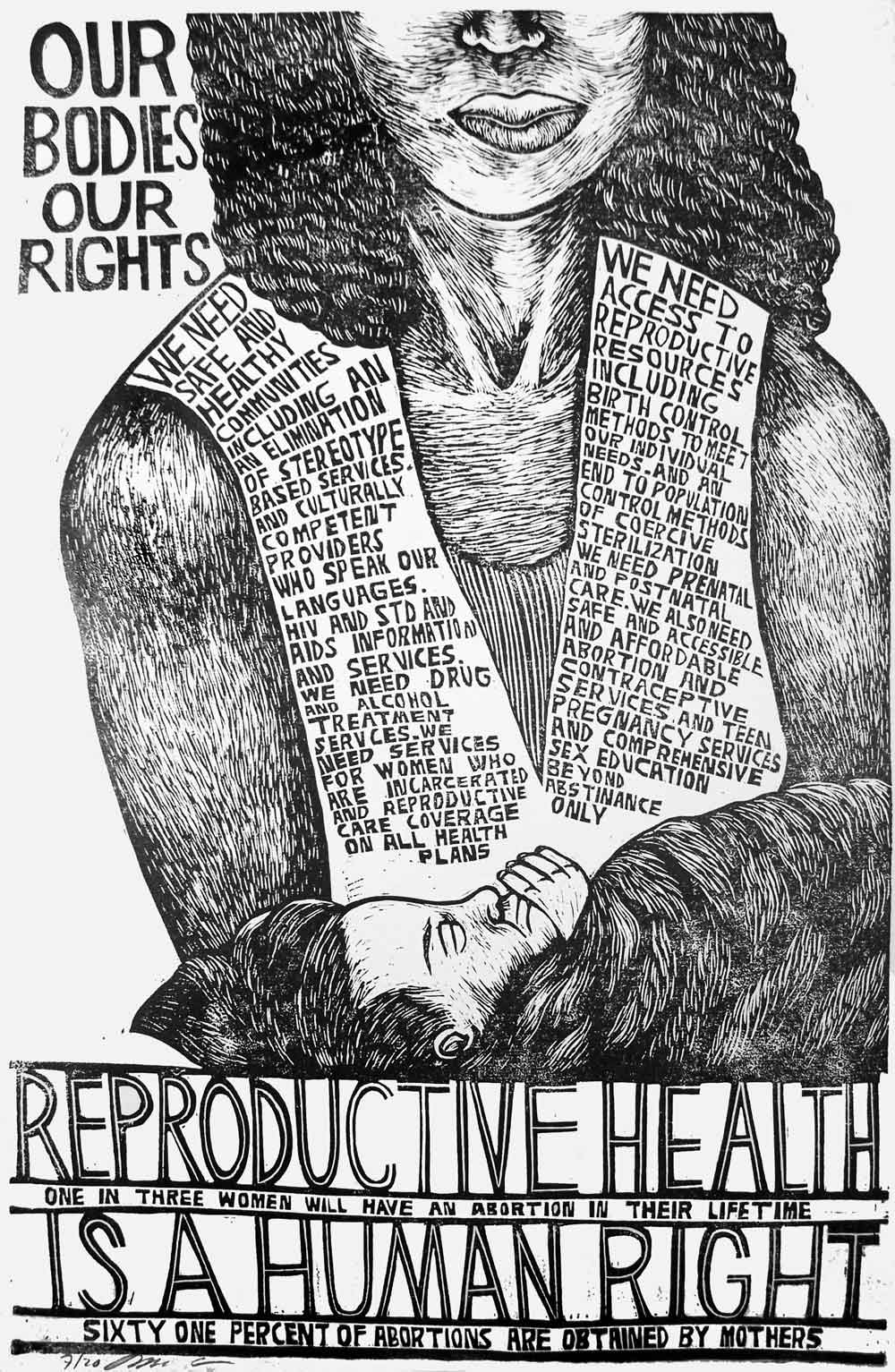
    These two sections will cover the following topics:                                                                              ![](https://socialsci.libretexts.org/@api/deki/files/119528/5.3.1_Our_Bodies_Our_Rights.jpeg?revision=2&size=bestfit&width=450&height=690)
    – Labor Organizing
    – Welfare Rights
    – The Fight for Reproductive Justice
    – The History of Reproductive Injustice

    _A_ ssigned Reading:

    1. [5.2 Fighting for Economic Justice.Links to an external site.](https://socialsci.libretexts.org/Bookshelves/Ethnic_Studies/New_Directions_in_Chicanx_and_Latinx_Studies_(Gonzalez_et_al.)/05%3A_Feminisms/5.02%3A_Fighting_for_Economic_Justice)
    2. [Links to an external site.](https://socialsci.libretexts.org/Bookshelves/Ethnic_Studies/New_Directions_in_Chicanx_and_Latinx_Studies_(Gonzalez_et_al.)/05%3A_Feminisms/5.02%3A_Fighting_for_Economic_Justice) [5.3 Reproductive JusticeLinks to an external site.](https://socialsci.libretexts.org/Bookshelves/Ethnic_Studies/New_Directions_in_Chicanx_and_Latinx_Studies_(Gonzalez_et_al.)/05%3A_Feminisms/5.03%3A_Reproductive_Justice)

    “ [Our Bodies Our RightsLinks to an external site.](https://justseeds.org/graphic/our-bodies-our-rights/)” by [Meredith SternLinks to an external site.](https://justseeds.org/artist/meredithstern/), [JustseedsLinks to an external site.](https://justseeds.org/) is licensed [CC BY-NC-ND 4.0](http://creativecommons.org/licenses/by-nc-nd/4.0).

    ### **Latinas in the Labor Movement**

    After you've finished reading the pages listed above, watch the following Time Magazine video from their series "The History You Didn't Learn" on the history of the important and integral contributions Latinas made to the labor movement. In this video, you will learn about the work of Latina labor organizers, Luisa Moreno and Emma Tenayuca-Brooks, who fought for workers' rights and paved the way for the famous labor organizer, Dolores Huerta, who would come to prominence roughly two decades later.

    This video is embedded in section 5.2 of your OER textbook.

    ### **Reflection Questions**

    As you read, take time to pause, reflect, and answer the following questions.

    1. How did Chicanas and Latinas challenge patriarchy, sexism, and homophobia in their ethnic nationalist movements and in the larger society?
    2. What are some of the key issues and movements that Chicana and Latina feminists have been involved in? What specific strategies did they utilize in their advocacy work?

  • [Solved] 6.3

    ✓ Verified Academic Solution Available

    Executive Solution Overview

    [>Economics homework help](https://www.sweetstudy.com/fields/business-finance-economics) before completing this assignment, so that you know what a thesis is supposed to do. **1.** **What does your thesis claim? What does it argue? Here is an example of a viable thesis: Steele's theory that stereoty…

    Instant Solution Download

    $6.99

    Immediate access to the full model answer, formatted citations, and rubric breakdown.

    Need a Fresh Custom Paper?

    Have this question answered from scratch according to your specific instructions and deadline.

    Order on TutorsGallery →

    Assignment Prompt & Instructions

    [>Economics homework help](https://www.sweetstudy.com/fields/business-finance-economics)

    before completing this assignment, so that you know what a thesis is supposed to do.

    **1.** **What does your thesis claim? What does it argue? Here is an example of a viable thesis: Steele's theory that stereotype threat negatively impacts the success of minority groups is valid. High schools and colleges should work together to focus on helping first-generation students adapt to college to help offset this threat.**

    – Notice that this thesis is arguable– many would disagree that only specific students face challenges in college that impact their success.
    – Notice that the writer of this thesis has to convince the readers that this thesis is a real solution to the problem and a good idea.
    – Notice that this thesis doesn't simply state the obvious or is an observation. This is an example of an observation, not a thesis: First-generation college students face difficulties that other students do not, therefore, they need extra attention to help them succeed.
    – This sentence states something the reader already knows. It's not an opinion that has to be defended or proven because it just is true. Go beyond this and write a claim or a solution to the problem that not everyone would agree with.

    **2. What part of your thesis is arguable? What won't some people agree with and why? Please explain.**

    Again, ask yourself: Is my thesis just an observation? In other words, am I stating something general like "there are pros and cons to this," or "there is a solution," which does not take a side or make an argument? If it isn't arguable, how can you make it so that it is?

    **3. What points will you have to bring up in your in order for your reader to be convinced that your thesis statement is truly a solution to the problem? (Hint: These points will be your body paragraphs)**

    1. Your thesis claims* (sentence #1- claim+reason, should+because):

    2. The points you'll bring up in the  are:

    3. The thesis is arguable because:

    Is your thesis just an observation? In other words, are you stating something general like "there are pros and cons to this," or "there is a solution," which does not take a side or make an argument? If you're having trouble with #3, it's probably because it isn't arguable.

  • [Solved] 6.2

    ✓ Verified Academic Solution Available

    Executive Solution Overview

    [>Accounting homework help](https://www.sweetstudy.com/fields/business-finance-accounting) In chapter seven of _They Say, I Say,_ the authors, Gerald Graff and Cathy Birkenstein write about "The Art of Quoting" and how to use the source information in your own writing effectively. In this assignment…

    Instant Solution Download

    $6.99

    Immediate access to the full model answer, formatted citations, and rubric breakdown.

    Need a Fresh Custom Paper?

    Have this question answered from scratch according to your specific instructions and deadline.

    Order on TutorsGallery →

    Assignment Prompt & Instructions

    [>Accounting homework help](https://www.sweetstudy.com/fields/business-finance-accounting)

    In chapter seven of _They Say, I Say,_ the authors, Gerald Graff and Cathy Birkenstein write about "The Art of Quoting" and how to use the source information in your own writing effectively.

    In this assignment, you'll  to this chapter and then use a template from chapter seven to revise your . The chapter starts on page 70 of the pdf linked below.

    Please choose a section from your  and revise the sentences using strategies from this chapter. You can use a couple of templates from the "introducing quotations" section and the "explaining quotations" section. For example:

    **Old sentences:** A quote by the author, Kavitha Cardoza, says that, "It’s not just the students who have to adjust to college; it’s a challenge for their families, too. For almost 20 percent of first-generation, low-income students, English is not a first language." This can be challenging.

    **Revised using templates (underlined):** Cardoza complicates matters further when she writes, It’s not just the students who have to adjust to college; it’s a challenge for their families, too. For almost 20 percent of first-generation, low-income students, English is not a first language." In other words, college culture shock does not only hit students, but the entire family as well. They literally don't speak the same language as the majority of people in college. This is a significant disconnect, not only in language but also in culture, traditions, and understanding of what college entails.

    – [\
    \
    They_Say_I_Say_3rd_Edition11.docx](https://www.sweetstudy.com/files/they-say-i-say-3rd-edition11-docx "They_Say_I_Say_3rd_Edition11.docx")